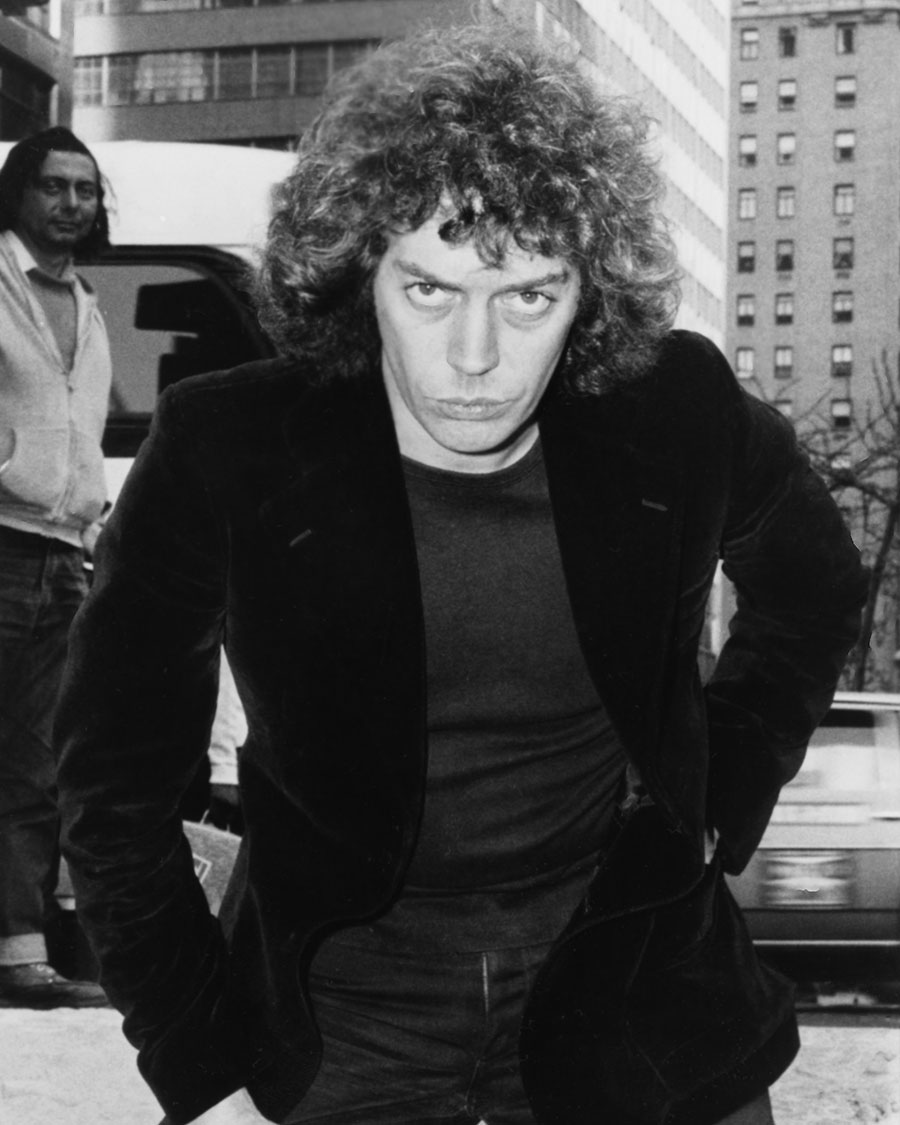
Tim Curry, the British-actor who had a brief stint as a rock singer in the late ’70s, died on August 25, 2026. He was 80.
Some artists approach the musical creative process from the outside, using the form as a vehicle for their own peculiar vision. In the late ’70s, Tim Curry’s major successes had been as an actor—the garter-belted Dr. Frank-N-Furter in the 1972 cult movie sensation The Rocky Horror Picture Show, as well as creating the title role in a six-part BBC production on the life of Shakespeare. But he had been bitten by the rock ’n’ roll bug, and he went on the road playing pop star to promote his Fearless album.
“It’s always been a matter of singing or acting for me,” the protean performer explained prior to a concert at Denver’s Rainbow Music Hall. “I just waited for control of my singing career before pursuing it seriously, and the acting parts came naturally in the meantime. But I’ve got the fever bad now, I’m afraid. I wouldn’t miss going out on the road. I get terrible stage withdrawal, anyway.”
The London-based Curry had surrounded himself with some stellar musical talent. The co-producers of Fearless were Michael Kamen and Dick Wagner. Kamen had directed the fortunes of the New York Rock Ensemble and worked as David Bowie’s musical director. Wagner had made a name as one of rock’s premiere session guitarists via his work with Alice Cooper. Together they gave credence to Curry’s excursion into rock music.
The trio met during the recording of Curry’s debut release, Read My Lips. The singer remembered it as “confusing—it was a very expensive album that changed style from song to song. It was so diverse that I think it discouraged people.”
Yet a subsequent tour changed Curry’s outlook and convinced him to start writing material as opposed to covering other people’s songs. Fearless was the result, a more accessible and intriguing recording than its predecessor. David Sanborn’s saxophone danced over the cheeky single “I Do the Rock,” an excellent example of Curry’s ability to incorporate wit and intelligence into a melodic statement. The song garnered rotation on MTV, and Fearless reached #53 on the Billboard chart.
“It’s definitely a New York album,” he stated. “It’s about America and money—cheap shots at expensive targets, I’m fond of saying.”
The considerable Rocky Horror following had given Curry some built-in support, but he maintained that his concerts reflected none of the campy outrageousness of his 1972 film performance.
“Nobody comes expecting to see Frank-N-Furter, and if they do, they’re going to be disappointed. I’ve turned down a lot of acting offers to work on this, and it is starting to pay off.” He laughed after hearing the seriousness of his words. “I behave quite badly out there, however. No sense standing behind a microphone with a gardenia in your hair, right?”
In the early ’80s, Curry returned to acting and lit up stage (Spamalot) and screen (Annie, Clue).